01 · Apply
Tell me about it
You tell me about the business and the opportunity. I take a limited number of these.
The Edge Brief
Clarity you can act on, in writing, within a week.
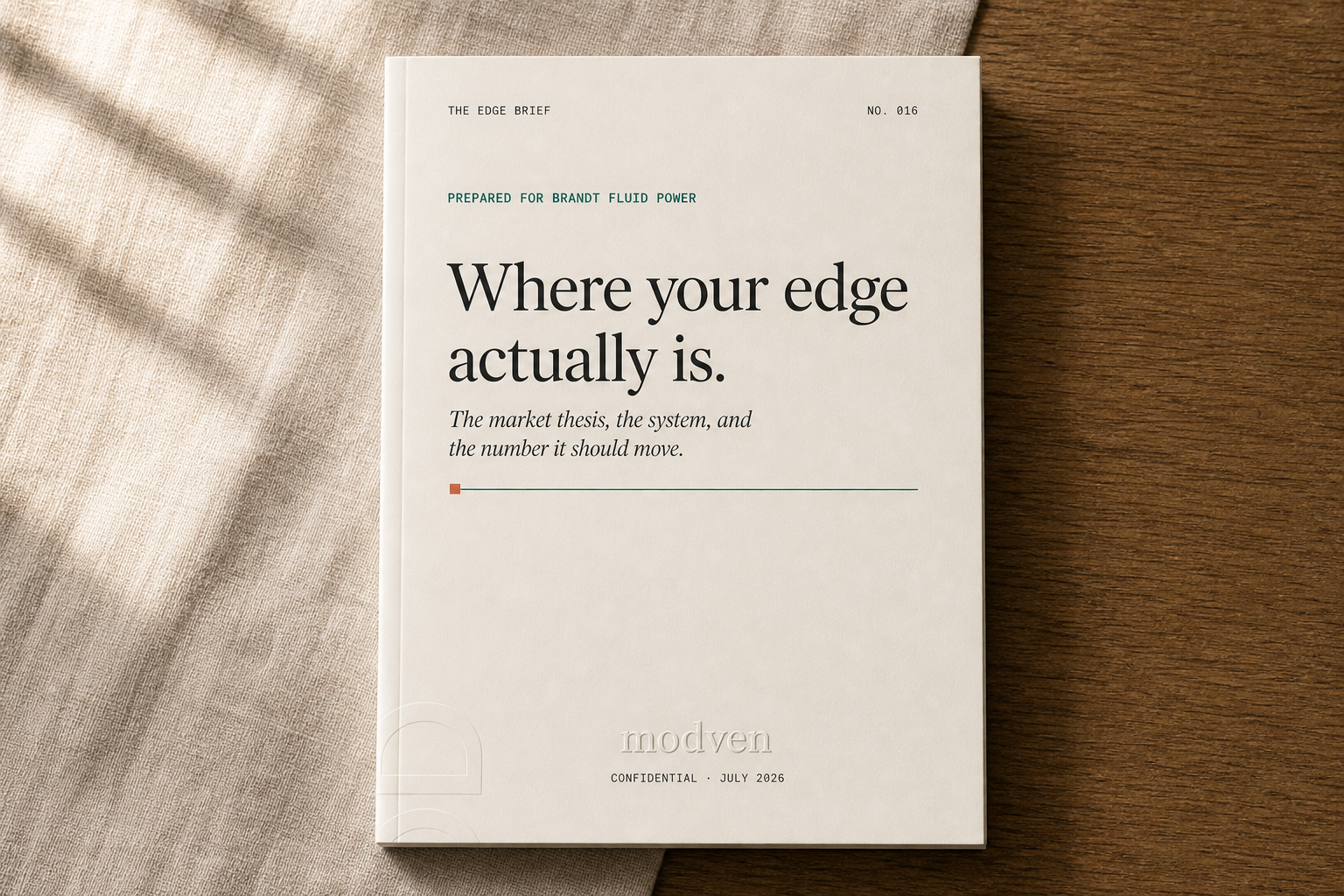
A paid working session and a written brief that names your real opportunity, the system I’d build to capture it, and the number it should move. It’s the fastest way to find out whether there’s something here worth building — and the only way I take on new work.
A decision, not a pitch
You pay for my full attention and my actual thinking, and you walk away with a document you could hand to your board whether or not you ever work with me. The session is a real working session — we get into your numbers, your market, and your constraints. The brief is the thinking, written down and made actionable.
What you get
Not notes, not a recap email. A structured document you can act on.
Delivered 5 to 7 days after our session. Yours to keep regardless of what happens next.
Every Edge Brief now includes a Foundry Screen: a one-page score of whether the problem we scope is unique to your company or common across your vertical. Most problems are yours alone, and the brief will say so plainly. When one isn’t, it may qualify for the Foundry — Modven’s thesis that a common problem, once solved, can become a company you hold founding equity in. The screen adds nothing to the price. It is how I make sure a second harvest never goes unnoticed.
What it costs, and why
If we go on to an engagement, that $500 comes straight off the price — you’ve lost nothing. If we don’t, you keep a board-ready document that’s worth more than $500 on its own.
It’s priced this way on purpose. A real price gets you my full attention and a real deliverable, and it makes sure we both treat the conversation like the decision it is.
Fit
How it works
You tell me about the business and the opportunity. I take a limited number of these.
We pressure-test the real opportunity together — your numbers, your market, your constraints. $500, paid on booking.
5 to 7 days later you get the written Edge Brief — the thesis, the system, the number, the path, and my read.
If we go on to an engagement, the fee is credited in full. If we don’t, the brief is still yours to act on.
I take roughly two engagements a quarter, by application. The Edge Brief is the only way in.
Q3 capacity · ▮▮▮ · 2 of 3 engagements committed
Questions
No. It’s a paid working session that produces a written document you keep. If anything, it’s how I screen out work that isn’t a fit — for both of us.
Then the brief says so, and walks through why. A clear “don’t build” saves you from spending real money on the wrong system, and the brief is yours to keep either way.
No. Plenty of briefs end with “here’s exactly what to do” and a client who goes and does it. The $500 credit is there if you want to build with me.
Because I do the work myself, end to end. The whole value is one accountable orchestrator, which only holds if I’m not spread across a dozen accounts. The constraint is the product.
The conversation can usually be booked within a couple of weeks; the brief follows 5 to 7 days after. Engagements start when capacity opens, which is why the brief is the right first move regardless.
It depends on the system — that’s exactly what the brief scopes. The brief is how we both find out, with real numbers instead of a guess.
One conversation, one written brief, one clear answer. It’s where every engagement begins.